Why Setting Height Determines Whether an Engagement Ring Truly Fits Your Life

Setting height is one of the most decisive elements in engagement ring design, yet it is often considered only after the centre stone and overall style have been chosen. In 2026, that order is shifting. Buyers are increasingly aware that how high a diamond sits above the finger affects not only how a ring looks, but how it feels, how it wears and how confidently it can be part of everyday life.
At its simplest, setting height refers to the vertical distance between the finger and the centre stone. A higher setting lifts the stone, creating a pronounced profile and allowing visibility from multiple angles. A lower setting brings the stone closer to the band, producing a more integrated, streamlined appearance. While both approaches can be beautifully executed, their impact on daily wear differs significantly.
Modern engagement rings are worn far more frequently than in previous generations. They are no longer reserved for evenings or formal occasions, but accompany their wearer through workdays, commutes, travel and leisure. As a result, the conversation around setting height has moved from aesthetics alone to include comfort, durability and confidence.
Fashion coverage from Vogue has explored how luxury accessories are increasingly expected to function as part of real wardrobes rather than as standalone statements. Jewellery is now chosen with the same consideration given to clothing and footwear, and engagement rings are no exception. Setting height plays a central role in whether a ring feels wearable or precious.
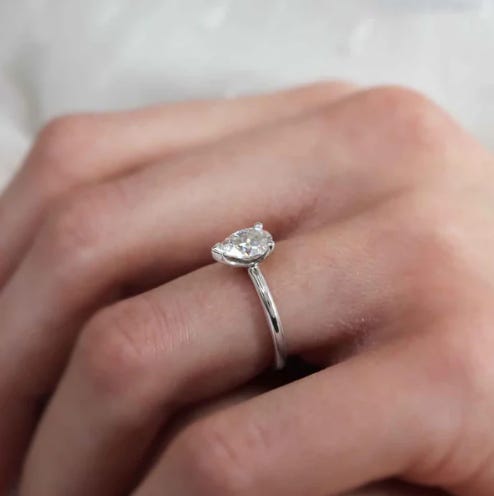
Historically, higher settings were associated with prestige and tradition. Elevating the diamond created visual drama and allowed light to enter from the sides, while also providing space for decorative metalwork beneath the stone. This approach suited lifestyles where rings were worn selectively and removed during manual tasks.
Lower settings were once viewed as practical rather than aspirational. Over time, that perception has changed. Contemporary design has reframed lower and mid height settings as intentional, modern and quietly confident. Rather than diminishing a diamond’s presence, they often enhance its relationship with the hand.
Gemological guidance from the Gemological Institute of America explains that a diamond’s brilliance is driven primarily by cut quality, not elevation. Advances in cutting precision mean that diamonds can perform exceptionally well in a range of settings. This understanding has helped dismantle the assumption that higher settings are inherently superior.
Comfort is often the most immediate factor influenced by setting height. Rings with excessive height can feel top heavy or unstable, particularly when worn continuously. They may catch on clothing, gloves or hair, or knock against surfaces during everyday tasks. Over time, these small interruptions can significantly affect how often and how happily a ring is worn. A rings ability to suit your lifestyle is equally important in the decision making.
Workplace research discussed by Harvard Business Review highlights how minor physical distractions can affect comfort and focus throughout the day. Engagement rings are increasingly evaluated in this context. A setting height that supports ease of movement can enhance confidence rather than demand attention.
Durability is another critical consideration. While diamonds are exceptionally hard, they can still chip if struck at vulnerable points. Higher settings expose the stone and prongs to more frequent impact, increasing the likelihood of maintenance over time. Lower settings reduce exposure simply through their construction.
Scientific insight from The Natural History Museum explains that despite a diamond’s hardness, sharp impacts can cause damage. The more exposed the stone, the greater the risk of cumulative knocks. Setting height therefore has a direct relationship with long term resilience.
Setting height also influences how an engagement ring works alongside other jewellery. Many people plan to wear their engagement ring with a wedding band. A very high setting can prevent bands from sitting flush, affecting comfort and visual cohesion. Lower or carefully balanced settings often allow for more harmonious stacking.
Design commentary in the Financial Times has noted that modern luxury increasingly values balance and coherence. Jewellery that integrates smoothly into a collection reflects a more considered approach to design. Setting height is fundamental to achieving that balance.
Visually, height changes how a diamond is perceived. Higher settings emphasise profile and elevation, while lower settings often highlight surface area when viewed from above. Neither effect is objectively better. The difference lies in what feels harmonious to the wearer and how the ring fits into daily life.
Cultural analysis from The Guardian has explored how understated choices are increasingly associated with assurance rather than restraint. In jewellery, this has translated into appreciation for designs that feel intentional and wearable. Lower and mid height settings often embody this sensibility.
Lifestyle changes have further amplified the importance of setting height. Hybrid working, frequent travel and less formal dress codes mean engagement rings are worn across a wider range of environments. Rings that adapt easily between contexts are increasingly preferred.
Social research from Pew Research Center shows how blurred boundaries between professional and personal life influence purchasing decisions. Jewellery choices now reflect a desire for continuity rather than switching identities. Setting height directly affects whether a ring feels adaptable or situational.
Importantly, choosing a lower setting does not mean sacrificing elegance. Modern prong designs, refined claws and bezel settings can maintain visual presence without excessive elevation. Many contemporary rings achieve impact through proportion and craftsmanship rather than height alone.
Design reporting from Dezeen has examined how jewellery increasingly draws inspiration from architecture. Structure, balance and material honesty are prioritised, encouraging designers to treat height as a deliberate structural decision rather than a default feature.
Higher settings remain meaningful for those drawn to traditional silhouettes and dramatic profiles. For some, elevation is an essential part of the ring’s character. The difference in 2026 is that these choices are made with awareness rather than assumption.
Luxury market insight from McKinsey & Company suggests that modern buyers value understanding over prescription. Knowing how setting height affects wear empowers individuals to make decisions that align with their lifestyle and expectations.
Retail conversations have evolved accordingly. Rather than treating height as a technical afterthought, it is now discussed alongside daily habits, work environments and long term wear. This holistic approach supports confidence and reduces the likelihood of regret.
Exploring contemporary engagement ring collections, such as those available through Lily Arkwright, reflects this thoughtful approach. Setting height is presented as a lifestyle decision as much as an aesthetic one, allowing buyers to consider how a ring will feel years down the line.
Setting height also shapes emotional attachment. A ring that feels secure and natural to wear often becomes an extension of the wearer rather than an object that requires caution. This ease can deepen emotional connection over time.
Psychological insight from Psychology Today suggests that people form stronger bonds with objects that integrate seamlessly into daily routines. An engagement ring that fits effortlessly into life can carry greater long term meaning.
Looking ahead, the importance of setting height is unlikely to diminish. As engagement rings continue to be worn as everyday jewellery, design decisions that support comfort and longevity will remain central.
Setting height matters because it shapes experience, not just appearance. It influences how a ring moves, how it feels and how confidently it can be worn.
In 2026, understanding setting height is no longer specialist knowledge. It is a personal consideration tied to lifestyle, confidence and self awareness.
When chosen with intention, setting height ensures that an engagement ring is not only admired, but genuinely lived with.